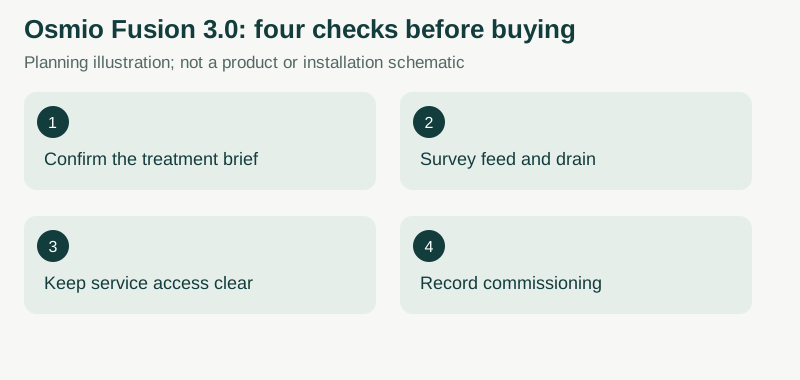
This Osmio Fusion 3.0 review examines practical fit, evidence limits, installation or handling, maintenance and alternatives. It is researched guidance, not a hands-on test.
The Osmio Fusion 3.0 is the more relevant of these two Osmio models if you want a mains-fed countertop drinking-water station instead of a manually refilled supply. That convenience comes with installation decisions that need settling before purchase.
Osmio advertises direct mains feed, hot, ambient and chilled dispensing, RO filtration, UV and hydrogen generation. This review does not verify its health or broad contaminant-removal claims.
Start with a kitchen plan. Where will the machine stand, where will the feed enter, and how will an installer reach the connections later? Ask for the current installation manual and a written assessment of the proposed feed, drain, pressure and electrical arrangement. A fitting kit does not establish that every kitchen is suitable.
If you rent, check permission for alterations before ordering. If you expect to move, include disconnection and reinstatement in your cost comparison. These questions can matter more than a small difference in the machine price.
Osmio lists approximately 500 ml per minute dispensing. Treat that separately from continuous cooling performance or the number of hot drinks available in succession. Ask the supplier to describe the operating limits for your expected busiest period.
Osmio clarified by email on 30 October 2026 that Fusion has a 2.5-litre internal tank supplying ambient and hot water. Chilled water uses a flow-through Peltier cooler without a separate chilled-water storage tank. This supplier clarification supersedes our earlier interpretation of the manual’s chilling-tank wording. Fusion is mains-fed with internal storage, not completely tankless. Nominal tank volume is not a verified usable draw-off capacity.
A neat installation that obstructs filter access is a poor long-term fit. Ask the installer to demonstrate how consumables are changed, how the unit is isolated and how it is serviced without straining tubing or cables.
Request a maintenance schedule and written consumables quote. Include cleaning products, filters, servicing, electricity and water use in your comparison. We have not established a reliable model-specific annual running total or recovery ratio, so no savings claim is made here.
If your confirmed objective is a drinking-water taste preference, ask whether a suitably specified carbon system would meet it. Paying for RO and temperature-controlled dispensing only makes sense if those functions answer your own brief.
Hydrogen generation does not determine our recommendation. Nor do we treat this dispenser as a whole-house softener. Match each treatment objective to evidence for the exact system.
Shortlist Fusion if you want to avoid manual supply refills and have a suitable installation route. Choose between Fusion and Zero by water handling, fitting and upkeep, rather than treating the installed version as automatically better at every task.
Before buying: obtain installation requirements, capacity limits, the maintenance plan, current filter prices and written warranty terms. See Osmio's current Fusion listing.
The Fusion manual V0.6 (1 October 2026) requires feed and drainage using ¼-inch tubing, with the drain saddle before the U-bend. It specifies at least 10 cm clearance on each side, outside a cupboard, and a dedicated socket rated at least 13 A without an extension lead or plug adapter. Leave additional access for maintenance.
The manual lists working pressure 0.4–0.6 MPa (4–6 bar), incoming water 5–38 °C, rated power 2200 W, dimensions 360 × 240 × 430 mm and net weight 9.6 kg. Its 30 L/hour production rating is distinct from dispensing and sustained hot/chilled output. A competent installer should verify the complete requirements for your supply.
Both manuals describe typical full-set filter life of six months, up to 12 months maximum depending on water quality and use. Follow earlier replacement indications and the complete cleaning, sanitisation and inactivity instructions. Read the Fusion manual.
Osmio confirmed by email on 3 November 2026 that Zero 3.0 and Fusion 3.0 have a two-year warranty in the UK. Its earlier reply said optional extensions are available at purchase. The reviewed manuals still state 12 months (Zero page 39; Fusion page 40). The latest email directs readers to the product-page Files tabs but does not attach full warranty conditions or explain the conflicting manual wording. Check those current downloads and retain the written terms, exclusions and maintenance requirements applicable to your order.
We reviewed Osmio’s shared declaration DOC-2025-I10002117 for Zero 3.0 and Fusion 3.0. It summarises materials/component safety testing attributed to Waltek under LFGB/BfR requirements, and electrical safety testing referencing SGS Fimko certificate FI-56678. The underlying reports and numerical results are not included. The substance list concerns materials safety, not proof that the filters remove those substances from incoming water. It supplies no contaminant-reduction percentages, filter-life performance or hydrogen health evidence. These are manufacturer-declared findings, not tests independently performed or authenticated by Limescale Logic. Read the shared declaration.
In its 3 November 2026 email, Osmio said its own performance results are unpublished and that it does not generally commission third-party testing for reverse-osmosis systems or distillers, tending to use it for inline filters instead. This is the supplier’s description of its testing approach. We have not reviewed those unpublished results or independently verified filtration-reduction performance for Zero 3.0 or Fusion 3.0. The reviewed conformity declaration remains evidence of its stated materials/electrical safety scope, not a substitute for model-specific filtration-performance results.
Osmio Fusion 3.0 review: the installation is part of the product
The central question in this Osmio Fusion 3.0 review is whether a mains-fed countertop drinking-water station fits your kitchen and routine. A permanent feed can remove the chore of manually refilling a supply tank, but it creates other decisions: where the feed and drain go, who installs them, how the machine is isolated, and what happens when it needs service. Those are part of the purchase rather than minor details to solve afterwards.
Our recommendation is therefore conditional. Consider Fusion when you specifically want its advertised RO dispensing format, prefer a mains-fed supply, and can obtain an acceptable installation plan. Compare Zero when avoiding permanent feed work is more important. Compare a simpler carbon-filter outlet when the defined objective is drinking-water taste and you do not need the dispenser functions. None of those alternatives is automatically best for every home.
This is a researched assessment. We have not installed Fusion, tested its water output, measured its power consumption or experienced its long-term reliability. The worked situations below are hypothetical planning exercises. They show what a prospective buyer should resolve without turning supplier descriptions into test results or inventing a story about ownership.
Start with the busiest five minutes in your kitchen
Imagine a household where one person wants a hot drink, another wants a chilled bottle and someone else needs access to the sink. This hypothetical situation makes the buying brief much more precise than a request for better water. The question becomes whether the dispenser, its position and its recovery limits support that sequence without making the kitchen harder to use.
Write down your own busiest sequence. Include volumes, preferred temperatures, vessel sizes and how many portions are needed consecutively. Tell the supplier what the sequence is and ask how Fusion behaves under those conditions. A dispenser may have the required modes without offering unlimited output at every temperature. We have not tested the relevant limits, so we do not make a family-capacity promise.
This also exposes whether the full dispenser is necessary. If everyone is satisfied with the kettle and only wants a different drinking-water taste, compare a specified filtered tap. If the appeal is consolidating several routines into one station, ask for evidence and a demonstration of those routines. The best brief explains what will change in daily use, rather than listing every feature the sales page contains.
Decide what you want to change about the water
RO is a treatment category, not a complete statement of need. Identify the water concern first. A taste preference, a named substance, a whole-house scale problem and uncertainty about a private supply do not become the same task because a machine is described as advanced. Write the objective in plain language and identify the information that supports it.
If you are responding to a water-quality result, ask for a model-specific report for the exact substance and relevant conditions. If the concern is ordinary taste, compare a suitable carbon route as well. If the supply may be unsafe or its quality is unknown, seek appropriate supply advice rather than treating a consumer dispenser review as a safety assessment. This review does not establish that treatment is needed in your property.
The point is not to avoid technology. It is to give technology a defined job. Once you can explain the job, you can evaluate whether Fusion provides the required treatment, whether its dispensing functions are useful, and whether an installation is justified. Without that sequence, it is easy to confuse an attractive appliance with an evidence-based answer to the original problem.
Mains-fed convenience is different from a promise of unlimited output
A permanent supply feed changes how raw water reaches the machine. It does not, by itself, establish unlimited treated-water availability, unlimited chilled output or any particular internal storage arrangement. Those limits should be answered from the current model's documents. We keep the description mains-fed because it is clear and does not imply that every internal tank has disappeared.
Ask Osmio to separate production, storage and dispensing. Production concerns the rate at which water is treated under specified conditions. Storage concerns usable volumes and operating levels. Dispensing concerns what leaves the outlet. Temperature recovery introduces another question. A single headline flow number cannot substitute for all four answers, even when the purchase page presents them close together.
Give the supplier a practical demand profile, such as the volume you want in one period, then request the applicable limits. If the response only repeats that the system connects to the mains, ask again about the actual sequence. The benefit of not manually refilling is real as a format difference, but the capacity you need still has to be established separately.
Resolve the tank wording before using it as a deciding feature
Osmio clarified by email on 30 October 2026 that Fusion has a 2.5-litre internal tank supplying ambient and hot water. Chilled water uses a flow-through Peltier cooler without a separate chilled-water storage tank. This supplier clarification supersedes our earlier interpretation of the manual’s chilling-tank wording. Fusion is mains-fed with internal storage, not completely tankless. Nominal tank volume is not a verified usable draw-off capacity.
Osmio describes chilled output as cup by cup, with approximately 3–10 minutes before the next chilled cup depending on room temperature. This is supplier guidance, not our measured recovery test or a guarantee. Confirm suitability for consecutive bottles or several users.
Internal storage needs the manual’s cleaning and inactivity care. We have not measured usable capacity, consecutive hot-water output or cooling recovery.
Plan the counter position and the service position together
A machine can fit attractively against a wall and still be difficult to maintain. Ask for the current dimensions, operating clearances and component-removal requirements before choosing the position. Then consider two layouts: the position during everyday use and the space required during a filter change or service visit. Both must work without stretching tubing, moving a heavy connected unit awkwardly or blocking access to isolation.
Measure the vessels you actually use and the space around the outlet. Check cupboard doors, sockets, splash areas and nearby appliances against the installation instructions. Do not assume that the proposed position is suitable merely because the base fits. The installer needs to assess the water, drain and electrical arrangements together, including the accessibility of connections after the kitchen returns to normal use.
Take photographs and measurements for the supplier or installer, but ask for a written assessment rather than relying on your own interpretation of them. A good installation plan describes the route and future access, not just the final appearance. This is where an apparently convenient mains-fed format can become either a genuinely practical arrangement or a source of avoidable servicing difficulty.
Ask the installer to map the feed route before quoting
The feed route should be identified for your exact kitchen, using the current model requirements. Ask where the connection will be made, how the system will be isolated and how the tubing will be protected and supported. Do not adapt another household's arrangement from a photograph or assume that a fitting supplied in the box resolves every connection in your property.
Ask the installer to explain which parts are included in the equipment package and which are additional. A written quotation should distinguish the machine, supplied fittings, extra connection parts, labour and any work needed to reach the chosen position. If an assumption changes when the installer arrives, it should be visible as a change to the plan rather than an unexplained addition to the final bill.
You do not need to become an installer to ask these questions. You need enough information to understand what work you are agreeing to and how the equipment can later be isolated or removed. Leave technical fitting decisions to an appropriately competent person following current instructions. A review should help you commission the work clearly, without pretending that generic installation steps suit every kitchen.
The drain route deserves its own check
The official Fusion product page includes drain-saddle guidance as well as feed-valve information. That establishes that drainage is part of the installation discussion; it does not make this review an installation manual. Ask the installer to identify the correct route under the current instructions and to explain any constraints imposed by your existing sink, trap, waste fittings or cupboard layout.
Discuss access as well as the initial connection. Can the relevant area be inspected later, and will normal cupboard storage put pressure on the tubing or fittings? What happens when the sink plumbing is serviced? These questions help avoid an installation that is technically connected but inconvenient to inspect or maintain. The answer should relate to the actual kitchen rather than an idealised drawing.
Do not improvise drain connections or infer acceptable methods from a different RO system. If the supplied guidance is unclear, have the installer obtain clarification before work begins. We have not assessed every plumbing arrangement and do not certify a proposed connection through this review. The practical recommendation is to make the drain route an explicit quoted item, with the applicable instructions identified.
Confirm feed-water and pressure requirements in writing
Request the current permissible feed conditions for the exact Fusion revision you intend to purchase. Ask about water quality, pressure, temperature and any required upstream measures. The existence of a mains connection does not establish that every feed arrangement is acceptable. We have not independently confirmed the complete current operating envelope, so this review does not supply a substitute set of numbers.
If the installer measures conditions, keep the results with the installation record and ask how they relate to the manual. If additional equipment is needed, have it listed with its purpose and maintenance requirements. Do not accept a generic assurance that the machine works in most houses as an answer to a condition that is important in your own property.
This is especially useful when a kitchen already contains other treatment equipment or an unusual supply arrangement. Describe what is present and ask how the proposed system should be configured. Do not assume that putting several technologies in sequence automatically improves the outcome. Each part needs a defined purpose, appropriate compatibility and a clear person responsible for its upkeep.
A powered water appliance needs a considered electrical position
Ask for the current electrical requirements and have the proposed connection assessed appropriately. The nearest socket may not be the right solution once water handling, access and the appliance instructions are considered. Do not plan on a temporary extension arrangement simply to avoid discussing the position, and do not conceal a connection that needs to remain accessible for service.
Think about the equipment already using the kitchen space and about how the machine will be isolated. Ask the installer or supplier which clearances matter and what should remain reachable. A tidy cable route should not obstruct a safe and practical maintenance procedure. We are not giving an electrical installation method; we are identifying a purchase question that belongs in the plan.
Also consider what normal operation means in that location. If the machine will stand near a dining area or a place used for calls, ask about sound and intermittent operating stages. If heating and chilling are important, obtain consumption information with its conditions. We have not measured those factors and do not infer them from photographs, a brochure adjective or a specification for a different dispenser.
Renting, worktop alterations and a future move
If you rent, obtain the necessary permission before ordering work that changes the kitchen. Ask what can be installed, what must be reinstated and who will pay for removal at the end of the tenancy. Do not treat a compact countertop unit as a guarantee that no property alterations are involved. The feed, drain and any route through furniture or worktop can matter more than the machine's size.
If a move is likely, include disconnection, transport, recommissioning and possible replacement fittings in the comparison. A mains-fed machine may still suit you, but the cost boundary should include the work needed to take it elsewhere. Ask the supplier what the model instructions require for moving and storage rather than assuming that unplugging it prepares it for transport.
For a household that wants the same general dispensing concept without permanent feed work, the Zero review provides the refillable alternative. That alternative replaces installation decisions with tank-handling decisions. Neither route removes responsibility; it changes the type of responsibility. Choosing deliberately between them is more useful than allowing the installed product to appear automatically better because it avoids one visible chore.
Commissioning should end with a handover, not just a working light
Ask the installer what checks and commissioning steps the current instructions require, and how completion will be recorded. The handover should identify the installed model, relevant components, isolation arrangements and the documents you need. It should also explain which initial procedures are complete and what the owner must do next. We do not substitute a generic flush volume for model-specific commissioning directions.
Have the person responsible for the machine attend the handover where possible. They should understand routine operation, how to identify a concern, who to call and where the maintenance instructions are kept. If several people will use the dispenser, do not assume that information given to one person will automatically reach everyone else.
Keep photographs of the completed accessible connections and the equipment label with the invoice and manual. These are useful records, not evidence of an independent performance test. They can make a future service conversation more efficient by establishing what was actually fitted. A good installation purchase includes this transfer of practical knowledge, rather than leaving the owner with a box of unused fittings and an unexplained operating unit.
Treat advertised flow as one part of the capacity picture
Osmio lists approximately 500 millilitres per minute dispensing. At that stated rate, half a litre would take about a minute and a litre about two minutes. These are calculations, not timed tests. They should be used to frame questions rather than to guarantee the time required for every temperature, starting condition or continuous-use sequence.
Ask whether the figure applies to the mode you expect to use and what other limits affect a long fill. Check vessel clearance and portion controls as well. A bottle that cannot sit securely beneath the outlet is not made convenient by a favourable flow rate. Similarly, the existence of a large portion setting would not establish the recovery time after several portions.
Avoid direct comparisons between outlet dispensing and a different system's nominal daily membrane-production figure. Those measurements can refer to different tasks under different conditions. A useful comparison asks each supplier about the same sequence: the same volume, target temperature, number of users and starting state. That approach makes a smaller set of comparable answers more valuable than a large set of unrelated numbers.
Chilled and hot demand should be assessed separately
A machine can have both settings while serving them under different limits. Ask how much chilled water is available consecutively, how recovery is defined and what room conditions affect the answer. For hot use, ask about successive portions and the control sequence. We have not tested either function and do not turn the presence of a setting into a promise of unlimited availability.
Think about your household's actual imbalance. Perhaps chilled bottles dominate in summer while hot drinks dominate on weekday mornings. Perhaps only one person cares about either function. List the tasks that would make you dissatisfied if the machine could not perform them. Those are the tasks to clarify before purchase, rather than treating occasional optional uses as the main buying criteria.
Ask for operating guidance for all regular users, including any lock and supervision requirements for hot dispensing. Do not describe a control as childproof without an appropriate basis. Position and vessel handling matter as well as the button sequence. A carefully chosen appliance can still be a poor fit if its output area is awkward for the people expected to use it.
Filter replacement access should be demonstrated
Before accepting a proposed location, ask how consumables are removed and replaced under the current instructions. Identify the access space and any isolation or preparation required. A machine that can technically be serviced after moving several connected items may not be as convenient as one whose service position was planned from the start.
Ask for the exact replacement codes and the schedule for each component. A general statement about filters lasting a certain number of months may not describe every element or every use condition. Record time limits, capacity limits and any reasons to change earlier. Do not calculate a replacement interval from your estimated daily volume alone when an applicable time limit may govern it.
If you plan to use a service company, ask what the visit includes and what remains the owner's responsibility between visits. If you plan to do permitted routine tasks yourself, obtain the current instructions and check that the household can carry them out. Neither arrangement is automatically cheaper or better; the relevant question is whether the full care plan will actually be followed.
Cleaning and sanitisation remain responsibilities after installation
A permanent feed does not remove the need to clean or sanitise the equipment according to its instructions. Ask which parts require routine attention, what products are permitted and how the machine is returned to service. The procedure for Fusion should be confirmed for Fusion rather than borrowed from Zero because the branding and some consumables appear similar.
Plan where necessary items will be stored and where removable components can be handled. Keep the manufacturer's warnings with the instructions. Do not shorten a maintenance procedure into a home-made checklist that accidentally omits an important stage. This review identifies the need for a plan without providing an unverified chemical recipe, dose or contact time.
Make a record of work completed, including the date, component code and any issue noted. Such a record is useful even when nothing goes wrong, because it prevents uncertainty about whether a task was done recently or merely discussed. It also gives the supplier context if performance or operation later changes. Maintenance should be visible in the ownership cost and the household routine from the beginning.
Holidays, inactivity and return to use
Ask for instructions covering short absences, extended absences and longer-term decommissioning. A connected supply does not mean the machine should be left in an assumed default state for every situation. Equally, the correct return procedure should come from the current manual, not from a general impression that running some water through any filter restores normal use.
If the property is occupied intermittently, make this part of the initial supplier brief. Explain how often it is empty and for how long, then ask what routine the model requires. The answer may affect whether the installed format is convenient for your actual calendar. This is not a claim that Fusion cannot suit occasional use; it is an unresolved suitability question until the applicable instructions are known.
Keep the isolation location and support contact accessible to whoever looks after the property. Do not give an untrained visitor a complicated maintenance task without guidance. If a service provider is responsible, clarify how an absence affects the next visit or consumable date. A realistic ownership plan includes the periods when nobody is making drinks, not just the busiest normal day.
Recognise a problem without inventing your own repair procedure
Ask the supplier which indications require stopping use, isolating equipment or contacting support, and retain the current troubleshooting instructions. If you notice a concern, record the model, symptoms, timing and recent maintenance. Photographs or a short description may help the supplier identify the issue, but a review should not diagnose an internal fault from a general symptom.
For a leak, electrical concern, unexpected behaviour or uncertainty about water quality, follow the manufacturer's safety guidance and obtain appropriate help. Do not dismantle the dispenser or bypass controls on the strength of online advice. We have not serviced this model, and we do not present speculative repair steps as ownership tips.
The purchasing question is how support works. Who handles the first call, what information is needed, and how are transport, labour and replacement parts arranged? Ask before buying if downtime matters to your household. A clear support route is a practical advantage that can be assessed without pretending to know the machine's future failure rate or relying on a few anecdotes as a reliability study.
Build an installed-cost quotation rather than comparing machine prices
Ask for an itemised quote covering the dispenser, required accessories, connection parts, labour and commissioning. Include any work needed to reach the preferred position or obtain permission. Keep optional items separate so you can see which costs are required for a functioning installation and which reflect a choice about appearance or convenience.
Compare the same scope when looking at alternatives. A bare carbon cartridge, a complete under-sink kit and a fully installed temperature-controlled RO station are not equivalent baskets. The lower headline number may omit a tap and fitting, while the higher number may include functions you do not need. The worksheet should describe the final working arrangement at the outlet.
Also ask what happens if the installation survey finds that the planned route is unsuitable. Clarify quotation assumptions before committing. A useful quote is a decision document: it tells you what will be installed, what is excluded and which conditions could change the price. This review does not publish a universal installation price because the property-specific work has not been assessed.
Five-year cost planning needs uncertainty, not just arithmetic
List replacement consumables, cleaning materials, service visits, water and electricity separately from the initial installation. Use the same ownership period for each alternative and show any assumed repair or replacement allowance separately. A planning total helps compare options, but it does not establish how long a machine will last or guarantee that no additional cost will arise.
Test more than one scenario. What happens if usage is higher, if a component needs changing earlier, or if you move during the period? Do not silently treat an unanswered cost as zero. An unknown item should remain visible so you know whether obtaining one more supplier answer could materially alter the comparison.
We have not verified a model-specific annual running total or recovery ratio for Fusion, and we have not measured its electricity use. Consequently, we do not claim that it will save your household money compared with a kettle, bottled water or another filtration system. Any such calculation would need a fair baseline, the actual usage pattern and all relevant costs shown.
Warranty and servicing conditions need the current model's terms
Osmio confirmed by email on 3 November 2026 that Zero 3.0 and Fusion 3.0 have a two-year warranty in the UK. Its earlier reply said optional extensions are available at purchase. The reviewed manuals still state 12 months (Zero page 39; Fusion page 40). The latest email directs readers to the product-page Files tabs but does not attach full warranty conditions or explain the conflicting manual wording. Check those current downloads and retain the written terms, exclusions and maintenance requirements applicable to your order.
Keep the purchase confirmation and applicable terms together. If there is an optional extension, ask what it adds and whether transport, labour or visits are included. If installation or servicing conditions affect cover, make sure the proposed arrangement meets them before purchasing. A clear answer should identify the document that applies to your exact model and order.
This is a documentation check, not legal advice. We do not use a generic statement about statutory rights to resolve an uncertain commercial warranty. Nor do we assume that an older third-party manual controls a current sale. When warranty certainty is a deciding factor, obtain model-specific written confirmation and keep it with the installation record.
Why hydrogen and UV do not justify a universal recommendation
The sales description includes hydrogen generation and UV. We distinguish those advertised features from independent evidence of a particular health or microbiological outcome. This review does not verify hydrogen health benefits or promise that the system makes an unknown supply safe. If a claim matters to your purchase, ask for the exact evidence and its limits.
Look for a match between the tested model, operating conditions and substance or outcome being claimed. A general paper about a technology does not necessarily establish performance of this complete dispenser in your kitchen. Similarly, a safety or materials declaration is different from a contaminant-reduction test. Each document should be used for the question it actually addresses.
Our practical recommendation therefore gives more weight to the fit between the format and the household: installation route, service access, usable capacity, operating routines and support. These factors are less dramatic than a broad wellness message but more directly connected to whether the equipment will be convenient and maintainable. Additional functions are worthwhile only when they have a clear purpose in your brief.
Fusion versus Zero: a different responsibility, not a better-owner hierarchy
Choose the comparison boundary carefully. Fusion changes the raw-water supply task by using a permanent feed. Zero requires refill handling but may avoid that installation work. Neither choice says anything about how committed someone is to water quality or how modern a kitchen should be. The right answer depends on permissions, access, capacity needs and the chores the household can manage.
For Zero, walk through the refill route and component handling. For Fusion, walk through installation, isolation and service access. Put the costs and responsibilities beside each other. If the main reason for preferring Fusion is avoiding manual refills, make sure the remaining installed arrangement is acceptable rather than overlooking it because one chore has disappeared.
Then request current specifications separately for both models. Similar temperature controls or branding do not prove identical usable capacity, cleaning instructions or warranty coverage. We do not transfer a numerical claim from one review to the other. The useful outcome is a documented choice between two operating arrangements, with the remaining questions made explicit before a seller asks for payment.
Fusion versus a simpler filtered outlet
If your objective is a defined drinking-water taste preference, compare a suitably documented carbon system before committing to the RO dispenser. The Q5586 and M9MP reviews explain two such shortlist candidates. They do not offer the same temperature-controlled station, and their claims should not be expanded to all substances or to conventional whole-house softening.
An alternative under-sink RO system is another research category when you want an RO drinking outlet without the same countertop dispensing format. For example, Waterdrop's official X8 listing describes an under-sink arrangement with its own faucet, power adapter, feed and drain components. We have not reviewed it hands-on or established it as a superior substitute; it is a competitor to research under a different installation brief.
The lesson is to compare outcomes, not just brands. Ask which treatment scope, outlet and functions you need, then compare complete installed arrangements. Do not let a machine-price comparison disguise differences in taps, cooling, heating, service requirements or usable space. A fair alternative is one that answers your actual brief, even if it looks different from the product you first noticed.
Our decision rule and the answers to obtain before ordering
Fusion belongs on the shortlist when mains-fed RO dispensing is a deliberate requirement and a competent installer can produce a suitable, maintainable plan. We would pause when installation permission, feed conditions, drainage, service access or warranty terms remain unresolved. We would also pause when the purchase is being used as a substitute for identifying the original water concern.
Send the supplier a concise description of the location and busiest usage sequence. Request current manuals, operating limits, usable draw-off capacity from the supplier-confirmed 2.5-litre ambient/hot tank, chilled output for your busiest usage sequence, consumable codes and schedules, cleaning guidance and complete-dispenser warranty terms. Ask the installer for a separate written description of the work. Together, those answers should explain both the appliance and the installation you will own.
Our conclusion is not a universal score. It is a clear route to a decision: confirm the water objective, establish why the dispenser format is useful, obtain the installation plan and check the ownership routine. If those pieces fit, follow the current product details with confidence in the questions you have resolved. If they do not, use the comparison to choose a refillable or simpler outlet route instead.
Alternative research: Waterdrop X8 official UK product information. This is a research lead, not an affiliate endorsement or a hands-on review.