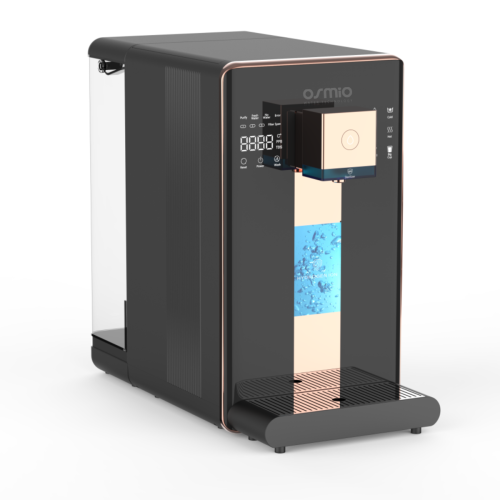
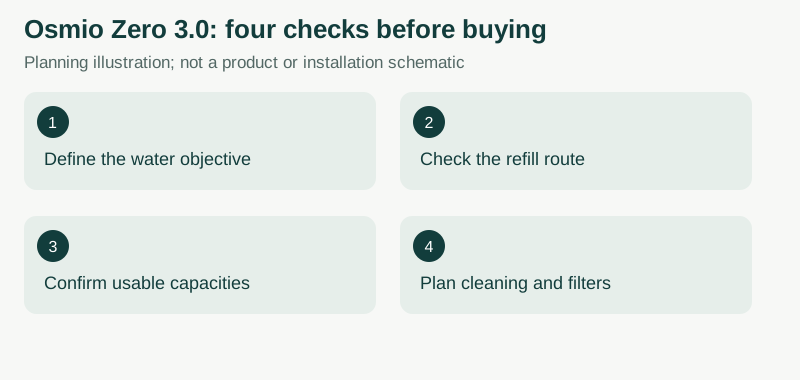
This Osmio Zero 3.0 review examines practical fit, evidence limits, installation or handling, maintenance and alternatives. It is researched guidance, not a hands-on test.
The Osmio Zero 3.0 is worth considering if you want a countertop reverse-osmosis drinking-water dispenser and accept the work of managing its supply tank and concentrated waste water. It is a different purchase from a system intended to reduce hardness throughout your home.
Osmio describes a three-stage system with a prefilter, RO membrane and carbon postfilter. It also advertises hot, ambient and chilled dispensing, UV and hydrogen generation. Those are manufacturer descriptions, not results established by Limescale Logic.
The useful first question is how you will use the machine. Will it serve one person's drinks, several morning coffees or repeated bottle filling? A feature list does not tell you whether a dispenser fits your routine. List the jobs you expect it to do before paying for temperature controls you may rarely use.
With a refillable unit, the recurring job moves from a permanent water connection to tank handling. Before ordering, establish where you will lift, empty, clean and refill the tank. Check the unit's current dimensions and the clearance required to remove components; a footprint alone is not a complete kitchen-space check.
Osmio states an approximate dispensing rate of 500 ml per minute. At that stated rate, a 250 ml portion takes roughly 30 seconds: an illustration calculated from the specification, not a timed test. Ask about chilled-water recovery separately if several people need cold drinks in succession.
Osmio says typical filter life is around six months, depending on usage and water quality, and calls for periodic sanitisation. Do not convert that into a guaranteed lifespan. Ask for the exact replacement codes, current instructions and the conditions that would require an earlier change.
Keep a simple ownership record: installation date, filter changes, cleaning, any fault and time out of use. This helps make a future comparison about the whole service rather than just the machine's purchase price.
We have not verified contaminant-reduction percentages or hydrogen health benefits for this model. UV and RO wording should not be treated as a promise that unknown or unsafe feed water becomes suitable for drinking. Ask for model-specific evidence for the exact substance or concern you have.
Osmio confirmed by email on 3 November 2026 that Zero 3.0 and Fusion 3.0 have a two-year warranty in the UK. Its earlier reply said optional extensions are available at purchase. The reviewed manuals still state 12 months (Zero page 39; Fusion page 40). The latest email directs readers to the product-page Files tabs but does not attach full warranty conditions or explain the conflicting manual wording. Check those current downloads and retain the written terms, exclusions and maintenance requirements applicable to your order.
Shortlist Zero when a refillable countertop drinking-water station fits your kitchen and maintenance routine. Compare Fusion if avoiding manual supply refills is your priority. Investigate conventional softening separately if your main problem is recurring scale at taps and showers across the home.
Before buying: confirm usable tank volumes, water-handling instructions, chilled recovery, replacement costs and the written warranty. See Osmio's current Zero listing.
We reviewed Zero manual V0.7 (6 August 2026). Page 38 lists dimensions 475 × 240 × 430 mm, net weight 11 kg and tank capacity as 6L/2.5L. That notation is not a verified usable treated-water capacity. Allow space for tank removal and handling as well as the machine footprint.
The placement instructions require at least 10 cm on each side, outside a cupboard, and a dedicated socket rated at least 13 A without an extension lead or plug adapter. The manual describes typical full-set filter life of six months, up to 12 months maximum depending on water quality and use. Follow earlier replacement indications and the complete cleaning, sanitisation and inactivity instructions. Read the Zero manual.
We reviewed Osmio’s shared declaration DOC-2025-I10002117 for Zero 3.0 and Fusion 3.0. It summarises materials/component safety testing attributed to Waltek under LFGB/BfR requirements, and electrical safety testing referencing SGS Fimko certificate FI-56678. The underlying reports and numerical results are not included. The substance list concerns materials safety, not proof that the filters remove those substances from incoming water. It supplies no contaminant-reduction percentages, filter-life performance or hydrogen health evidence. These are manufacturer-declared findings, not tests independently performed or authenticated by Limescale Logic. Read the shared declaration.
In its 3 November 2026 email, Osmio said its own performance results are unpublished and that it does not generally commission third-party testing for reverse-osmosis systems or distillers, tending to use it for inline filters instead. This is the supplier’s description of its testing approach. We have not reviewed those unpublished results or independently verified filtration-reduction performance for Zero 3.0 or Fusion 3.0. The reviewed conformity declaration remains evidence of its stated materials/electrical safety scope, not a substitute for model-specific filtration-performance results.
Osmio Zero 3.0 at a glance: start with the way you use water
An Osmio Zero 3.0 review needs to answer a more useful question than whether the machine has an impressive feature list. Does a refillable drinking-water dispenser fit your household well enough to justify its space, water handling and ongoing care? That question stays relevant even if the price changes. A machine can offer functions you like and still be awkward in the particular kitchen where you intend to use it.
Our starting recommendation is conditional. Put Zero on your shortlist when you specifically want a countertop RO dispenser, want to avoid arranging a permanent feed, and can comfortably manage the tank. Pause when your objective is simply to reduce scale across the property, when tank lifting is difficult, or when you cannot explain why you want RO rather than a simpler drinking-water filter. Different objectives lead to different purchases.
We have not used this machine in our own kitchen, timed it, sampled its output or assessed its reliability. The practical exercises below are planning tools. They help you turn supplier information into a buying decision without pretending that a researched review is a hands-on test. Where a question is unresolved, the honest answer is to obtain the missing information before spending money.
A kitchen example: the morning queue matters more than a long feature list
Consider a hypothetical household with two people making hot drinks and a third filling a bottle before work. Their real requirement is not merely access to hot and cold water. It is enough water at the right temperature, at the times they need it, without someone having to refill and clean a tank in the middle of the rush. This is an example, not an account of our own use.
Write down your equivalent morning sequence. Include a full bottle rather than just a small glass, and include the person who uses the kitchen after everyone else. Then ask Osmio which parts of that sequence the machine can support consecutively. A dispensing flow figure answers one part of the question. It does not establish chilled-water recovery, repeated hot-water output, usable tank capacity or the time spent handling water.
This exercise also reveals when a simpler arrangement might work. If your kettle already suits the hot-drink routine and you only want different-tasting cold water, a dispenser with several temperature settings may solve more problems than you actually have. If replacing several separate routines is the attraction, ask the supplier to demonstrate that complete routine rather than relying on a list of modes.
Separate treatment, dispensing and convenience before comparing prices
There are three decisions inside this purchase. The treatment decision concerns what you want to change about the water and what evidence supports that change. The dispensing decision concerns temperature, portion sizes and availability. The convenience decision concerns refilling, cleaning, space and the number of people who will use it. Treating these as one decision makes it easy to pay for a benefit you have not defined.
Make three short lists. Under treatment, write a specific objective rather than a broad word such as purity. Under dispensing, record which temperatures and volumes matter. Under convenience, record the jobs you want to avoid and the jobs you are willing to take on. You might be happy to refill a tank but unwilling to alter a worktop, or comfortable arranging an installation but unwilling to carry water every day.
Ask suppliers to answer the lists separately. A reply about filtration stages is not an answer about cleaning access. A reply about having chilled water is not an answer about successive bottle fills. Once you separate the questions, you can compare Zero with Fusion and with a conventional filtered outlet without making an artificial claim that one product is best at every task.
Find the water question before deciding that RO is the answer
Start with the information available about your supply and with the problem you can actually identify. Perhaps your concern is a consistent taste preference. Perhaps it is a particular substance mentioned in a water-quality report. Perhaps it is scale in appliances. These are different briefs. A treatment technology should be selected because it addresses a defined brief, not because the name sounds comprehensive.
For an ordinary taste preference, compare the evidence and upkeep of a suitably specified carbon system as well. For a specific substance, request a model-specific reduction report with test conditions and service limits. For unknown or potentially unsafe water, seek appropriate supply advice; do not treat a domestic dispenser's sales language as a general safety guarantee. This review does not establish that your household needs treatment.
Record the source of the concern and the outcome you would regard as worthwhile. A useful note might say that the objective is preferred drinking-water taste at one kitchen outlet. A less useful note says that every dissolved constituent must be removed. Defining the objective makes it easier to identify when additional functions are relevant and when they are simply additional cost and maintenance.
What the three advertised stages do not prove on their own
Osmio describes a prefilter, RO membrane and carbon postfilter. That is useful information about the arrangement it markets, but a stage count does not establish a measured result for every substance. The important evidence would identify the exact system, the substance, the feed conditions, the test method and the point in the service life at which performance was assessed. Those details matter more than the number of stages.
If a seller supplies a certificate, check what is actually certified. A component certificate, a materials approval and a whole-system reduction claim have different scopes. Ask whether the model code on the report matches the machine being sold, including any suffix or revision. If it does not, ask for an explanation rather than assuming that a similar-looking model is equivalent.
We have not independently established model-wide reduction percentages for Zero 3.0. Consequently, our recommendation rests on suitability and the clarity of the questions a buyer can resolve. We do not attach a health score to the filtration description. A clear limit is more helpful than a performance claim that appears specific but cannot be traced to evidence for the product in front of you.
A footprint tells you whether the base can sit on a worktop. It does not tell you whether the tank can be removed beneath a wall cupboard, whether a full tank can travel safely to a sink, or whether someone can refill it without moving other appliances. Ask for current dimensions and component-removal clearances, then measure the whole activity rather than drawing a rectangle around the machine.
Try a dry planning exercise with an ordinary empty container. Identify where you would stand, where the tank would rest, how cupboard doors would open and where water would be added. Do not imitate any machine procedure without its instructions; this is simply a check of the kitchen route. Include the space occupied by drying items, a dish rack and the things that normally live beside the sink.
If several people will refill the unit, ask each person whether the proposed route works. Reach, grip and confidence vary. A location that seems convenient to the purchaser may be difficult for another regular user. The best counter position is the one that supports routine care as well as attractive photographs of a tidy kitchen.
Usable capacity is the number to ask for
A total tank volume can be a poor guide to the water available between chores. Ask Osmio to distinguish raw-water volume, usable treated-water availability, any minimum operating level and the handling of concentrated water. We have not verified these volumes for the current model, so we do not turn a headline capacity into a claim about how many drinks your household will obtain.
Explain your expected use in litres rather than relying on words such as busy or family-sized. Count a normal day and a busier day separately. Include cooking water only if you intend to obtain it from the dispenser, and include visitors if they are a recurring part of the routine. The supplier can then answer a concrete capacity question.
Do not fill a gap in the specification by estimating from photographs. Internal shapes, operating limits and usable volumes need not match what the outside suggests. If capacity is the deciding factor, make a written answer a condition of your purchase decision. That is particularly worthwhile when the unit would replace an existing arrangement that already serves the household reliably.
Understand the concentrated-water job before ordering
Reverse-osmosis water handling is part of the ownership brief. Ask for the current instructions explaining how the Zero separates and handles its raw and concentrated water, how often the relevant compartments require attention and what triggers a change. Do not infer a recovery ratio from a broad efficiency statement or from another Osmio model's instructions.
When the supplier provides a ratio, ask for the operating conditions and what the figures include. A production ratio may not describe cleaning, flushing or all water handling over a month. For budgeting, distinguish water delivered to a glass from all water used by the system. If the information is unavailable, leave the cost line uncertain rather than presenting an invented annual total.
Also plan the physical task. Where will water be carried, what surface will it rest on, and what happens if someone cannot attend to the unit that day? Follow the manufacturer's disposal and refill directions rather than improvising a reuse routine. An apparently minor chore becomes important when it is repeated often, so it belongs in the comparison before purchase rather than after the return period has ended.
Interpret the stated dispensing rate without mistaking it for a test
Osmio advertises approximately 500 millilitres per minute dispensing. Simple arithmetic gives about half a minute for 250 millilitres and about two minutes for a litre at that stated rate. These are calculations from a supplier figure, not measurements we made. They do not account for any pauses, temperature recovery, operating mode or other conditions that may affect a real sequence of use.
Use the arithmetic to ask a better question. If you regularly fill a litre bottle, ask how the machine handles that amount at your preferred temperature. If three people use it consecutively, ask for that sequence. If you use a tall vessel, check physical fit as well as the volume selection; a nominal dispensing capacity says nothing about the space beneath the outlet.
Avoid comparing the advertised number directly with a different product's daily membrane-production rating. One describes delivery at the outlet and another may describe water production under specified conditions. A meaningful comparison puts the same task on both sides: the same vessel, target temperature, starting condition and number of successive portions. Without that boundary, a larger number can give a misleading impression of speed.
Ask about chilled recovery separately from cold-water availability
The presence of a chilled setting does not establish how much chilled water will be available consecutively or how long the machine takes to recover. Those are capacity questions that should be answered for the current unit and the ambient conditions relevant to your kitchen. We have not tested them and do not infer them from the existence of a cold-water control.
Describe the busiest likely use: for example, several bottles before a school trip or glasses for visitors after a warm afternoon. Ask the supplier how output temperature is defined, how room temperature affects operation and what happens when demand exceeds the available chilled supply. A useful reply should address sustained use rather than simply confirming that the unit can chill water.
You may discover that chilled performance is not important enough to drive the purchase. Some households mainly want ambient drinking water and occasional hot drinks. Others will use the cold function heavily. Knowing which group you belong to prevents an occasional feature from dominating the decision, and it makes it easier to compare a dispenser with a filtered tap plus your existing refrigerator routine.
Treat hot-water access as a household-use question
Before using any hot-water dispenser, read the current model instructions and ensure every regular user understands the controls. Ask Osmio about the lock, available settings, operating sequence and any limits relevant to children or visitors. We do not certify the controls as childproof, and a lock symbol should not replace supervision or sensible placement.
Think about the vessel as well as the control panel. Can the intended mug or jug sit securely, can the person see the outlet clearly, and is there a safe route away from the machine? A purchase assessment can identify those questions without inventing a demonstration. Do not assume that a machine suitable for one adult's cup is automatically suitable for every person's reach or grip.
If hot drinks are the main reason for buying, ask for a demonstration of the exact routine and compare it with your existing kettle. Consider availability, portion selection, cleaning and access. We have not measured temperature accuracy, energy use or the speed of a hot-drink cycle. Any claim that Zero saves money or time for your household would need those measurements and a fair comparison boundary.
Hydrogen and UV do not determine our recommendation
Osmio markets hydrogen generation and UV as features of the system. We report that positioning without treating it as independent evidence of a health benefit or a universal microbiological safeguard. This review does not recommend the unit on the basis of hydrogen-related health claims. If those claims are central to your interest, request the evidence and consider what it actually measures.
The same discipline applies to UV wording. Ask what component is involved, which operating conditions matter, what maintenance is required and which exact claim is supported. A feature name alone does not establish that an unknown feed-water source can be made suitable for drinking. Do not substitute a consumer product review for advice about an unsafe or uncertain supply.
For most buying comparisons here, the more immediate decisions are water handling, installation preference, available space, maintenance access and documentation. Those are concrete differences a household can evaluate. Putting them first also avoids allowing an unfamiliar technical term to overshadow an everyday limitation, such as an inconvenient refill position that would affect every person using the kitchen.
Build a maintenance plan before you buy replacement filters
The supplier describes a typical filter life around six months, with variation according to use and water quality. Treat this as an expectation to clarify, not a guarantee. Request the exact current consumable codes, the maximum time limits, any capacity limits and the conditions that require earlier attention. Record different components separately if their instructions differ.
A useful maintenance plan names the task, the instruction that governs it, the responsible person and the next review date. It should distinguish routine cleaning from a filter replacement and from any sanitisation procedure. Avoid writing a single reminder that says service machine, because that does not tell the next person what was completed or what remains due.
Before ordering a spare, compare the code on the supplier documentation with the replacement listing. Similar model names are not sufficient proof of compatibility. Keep the invoice and instructions with the machine's record, and note any revision. This small administrative step can prevent a later reorder from becoming a search through old emails or an assumption based on a product photograph.
Cleaning access is an everyday feature, even when it is absent from the headline
Ask for the current cleaning instructions before deciding where to put the unit. You need to understand which parts require access, what materials are allowed, what drying or reassembly is involved and how the machine is returned to use. This review intentionally does not supply a home-made cleaning recipe or adapt procedures from a different Osmio generation.
Think about where removable parts will rest during the process and where instructions will be available. A cleanable component can still be inconvenient if there is nowhere to handle it without moving groceries or drying dishes. Include the time needed to prepare and clear the area, not merely the moment when a part is wiped or rinsed.
If someone else looks after the kitchen while you are away, make the responsibilities clear. Leave the manufacturer's procedure rather than a shortened version that omits warnings. The practical question is whether the household can repeat the required care consistently. Maintenance that fits naturally into your routine is a stronger benefit than a promise that a machine is easy to own without a description of the tasks.
Plan for holidays and periods when the machine is unused
Ask Osmio how the current model should be prepared for a short absence, a longer holiday and a return to service. These are distinct situations and may require different instructions. Do not assume that emptying the visible tank addresses every component or that a general rinse is sufficient after a long period without use.
Your own calendar matters. A machine used throughout the year has a different routine from one in a kitchen that is unoccupied for several weeks at a time. If long absences are common, include the preparation and restart tasks in your ownership comparison. This is not a finding that Zero is unsuitable; it is a reason to obtain the applicable directions before purchasing.
Keep a dated record of any shutdown and restart. That can help a service provider understand the circumstances if a problem develops later. Follow model-specific guidance and contact the supplier if instructions are unclear. A review can usefully identify the question, but it should not invent a safe storage interval or a re-commissioning process for a machine it has not tested.
Noise, heat and electricity need answers for the proposed position
We have not measured operating sound, surrounding temperature or electricity consumption. If these matter to you, ask for current specifications and their test conditions. A quiet daytime kitchen and a room used for calls or early-morning work may place very different demands on the same appliance. A subjective claim such as unobtrusive needs context.
Ask which operating stages create sound, whether heating or chilling operates intermittently, and what clearances the instructions require. Check the proposed location against the manufacturer's electrical requirements with appropriate advice where needed. Do not plan an improvised extension arrangement simply because a convenient socket is absent, and do not assume that every countertop position is suitable for a powered water appliance.
For energy budgeting, ask whether a quoted figure includes hot and chilled functions, standby periods and the volume you expect to dispense. A daily figure measured under one usage pattern may not describe another household. If no comparable evidence is available, keep the electricity line provisional. That is more transparent than claiming a saving over a kettle without measuring both systems under the same conditions.
Create a worksheet with separate lines for purchase, delivery, any required accessories, replacement components, cleaning materials, servicing, water and electricity. Add optional warranty extensions only if you intend to buy them. The aim is to see what the whole arrangement costs, not to produce an attractive annual number by leaving uncertain items out.
Use a consistent period, such as five years, when comparing alternatives. A planning total is the initial cost plus expected recurring costs over that period, with repairs and replacement assumptions shown separately. It is not a reliability prediction. If you do not have enough information for a line, write unknown and ask the supplier rather than entering zero.
Try a normal-use and higher-use scenario using the same assumptions for both products. Show how a shorter consumable interval changes the total. Do not carry a filter-life assumption from Zero into Fusion or a carbon kit without checking each system's instructions. A useful cost comparison makes uncertainty visible and tells you which unanswered question could change the purchasing decision most.
Warranty wording should be tied to the complete dispenser
Osmio confirmed by email on 3 November 2026 that Zero 3.0 and Fusion 3.0 have a two-year warranty in the UK. Its earlier reply said optional extensions are available at purchase. The reviewed manuals still state 12 months (Zero page 39; Fusion page 40). The latest email directs readers to the product-page Files tabs but does not attach full warranty conditions or explain the conflicting manual wording. Check those current downloads and retain the written terms, exclusions and maintenance requirements applicable to your order.
Before ordering, retain the terms applicable to your actual purchase, including the seller, date, product code, exclusions and any maintenance conditions. If you choose an extension, ask what additional period and components it covers and how a claim is made. Clarify whether transport, labour or a service visit is included rather than assuming that the word warranty answers all three.
This is a purchase-document check, not legal advice. We do not repeat generic claims about statutory rights as a substitute for the supplier's terms. If warranty certainty would determine whether you buy Zero, resolve it in writing first. A helpful salesperson should be able to identify the applicable document or refer the question to someone who can.
Zero versus Fusion: choose the water-handling arrangement first
Zero is the refillable candidate in this pair; Fusion is the mains-fed candidate. Start with that distinction. The ability to avoid a permanent feed may suit a renter or someone who does not want installation work, but it brings an ongoing handling routine. A mains-fed machine may remove manual supply refills while introducing installation and future disconnection decisions.
Neither arrangement is automatically superior. Compare the physical tasks, permissions, space and upkeep in your kitchen. If you cannot comfortably handle the refill route, the convenience of avoiding plumbing may not be a convenience for you. If you cannot arrange an acceptable installation, the promise of a connected feed may not be available in practice.
Then compare the model-specific functions that matter, using current documents for each. Do not assume that similar branding makes all capacities, warranties and procedures identical. Our separate Fusion review focuses on the installation route. Reading both should leave you with a more precise question for the supplier, rather than a belief that a higher price or a permanent connection establishes a universal performance winner.
Zero versus an under-sink carbon system
The Omnipure Q5586 kit and Microfilter M9MP represent a different type of shortlist: a specified drinking-water filtration outlet rather than a temperature-controlled countertop station. They are useful comparisons when you are trying to identify how much equipment your objective requires. They are not interchangeable examples of the same treatment or dispensing function.
If your brief is taste at a kitchen outlet, ask whether a documented carbon option can meet it. Consider the complete kit, tap, installation and replacement schedule. If your brief specifically requires RO or hot and chilled dispensing, ask which evidence supports those requirements and whether the dispenser is the preferred way to deliver them. Avoid comparing only the lowest equipment price.
We do not infer broad contaminant reduction, hardness removal or safety outcomes from the word carbon, just as we do not infer them from RO branding alone. The comparison should use the exact claim and system. A smaller system can be the sensible choice when its scope matches the task; a larger feature set can be sensible when you can explain the additional functions you will actually use.
Reasons to shortlist Zero, and reasons to pause
Shortlist it when the refillable format is a deliberate preference, the counter and refill route work for everyone who will use it, and the desired dispensing functions justify the maintenance. Its main practical attraction in our assessment is the combination of a countertop format and the absence of a permanent supply-feed installation. That is an editorial suitability judgement, not a measured advantage in water quality.
Pause if you are buying it to protect every tap and shower from hard-water scale, if you cannot manage the required handling, or if your decision depends on a performance or warranty claim that remains unclear. Pause also if the proposed location fails the manual's requirements. Waiting for an answer is cheaper than using the return process to discover what the specification should have said.
Do not turn those cautions into a claim that the product is poor. They identify the boundary of the recommendation. A review is useful when it helps the right buyer recognise a fit and the wrong buyer recognise a mismatch. The same machine can be a sensible purchase for one household and unnecessary complexity for another.
Your pre-order checklist, written for the supplier
Send a short description of your intended use and location with your questions. Ask for current usable capacities, removal clearances, chilled recovery, successive hot-water availability and the water-handling routine. Request current manuals, consumable codes, cleaning requirements and complete-dispenser warranty terms. If a particular substance is your concern, name it and request evidence for that exact claim.
Keep the answers together rather than scattering them across a basket, a telephone conversation and several browser tabs. Mark which answers are confirmed documents and which are general sales guidance. If a supplier changes a specification before the order, ask which version applies to the item you will receive. This creates a practical purchase record without requiring you to become a water-treatment engineer.
The final decision should fit in a few sentences: why this treatment scope, why this dispensing format, why this location and what care you accept. If one of those sentences is missing, do more checking before buying. You can then follow the affiliate link with a defined brief instead of allowing the purchase page to define the brief for you.
How we would update this researched assessment
We would revise the review when model-specific documents resolve capacities, operating limits or warranty questions, or when reliable evidence changes a claim. A supplier reply is useful evidence of what the supplier states; it is not automatically an independent performance test. We would distinguish those two things in any update rather than quietly changing the label on the review.
We would also change the recommendation if the purchase options, maintenance support or model revision changed materially. Reviews need maintenance just as equipment does. The original research date and update date should help readers understand which information was available, while links to the current seller allow them to check the terms offered at the time they order.
For now, our conclusion stays practical: Zero deserves consideration when you want the refillable countertop RO format and can resolve the ownership questions above. It is not our universal recommendation for hard water, every kitchen or every drinking-water concern. The most useful next step is a model-specific answer to your own remaining question, followed by a comparison with the simpler and installed alternatives.
Questions readers often need to settle before deciding
Can Zero replace a whole-house water softener? We would not choose it for that task. This review concerns a drinking-water dispenser at one location. A brief involving scale throughout the property needs its own assessment of hardness, outlets and treatment routes. Do not let a countertop unit's RO description silently change the scale of the result you expect around the rest of the home.
Can it replace a kettle? That depends on the hot-drink tasks, capacities and operating conditions you confirm with the supplier. We have not measured its temperatures, recovery or energy consumption. Write down the vessels, volumes and successive drinks that matter, then compare that routine with the current kettle. A mode name alone does not establish equal convenience or a saving for your household.
Is the UK warranty duration confirmed? Osmio’s 3 November email confirms two years. Keep the current model-specific written terms for the order, including conditions and any optional extension. The reviewed manuals’ 12-month wording remains inconsistent with that supplier confirmation.
Should a low-use household wait longer to replace a filter? Do not assume so. Obtain the applicable time and capacity limits for each current component and follow the relevant instructions. Lower volume does not automatically override a maximum time limit, cleaning requirement or inactivity procedure. The ownership plan should identify which limit governs the actual use pattern.
What if the answers remain unclear? Keep the decision open and compare another format. The affiliate link is an option for checking current details, not a deadline to buy. A supplier who can clearly explain the equipment, service routine and applicable terms gives you a better basis for a purchase than an attractive feature list with unanswered questions.