
Researched product guidance · Updated 2 November 2026
Microfilter M9MP review: check the package before comparing the price
Affiliate disclosure: Some links on this page are affiliate links. If you buy through one, Limescale Logic may earn a commission at no extra cost to you. We have not hands-on tested these products. This researched assessment uses the sources linked below.
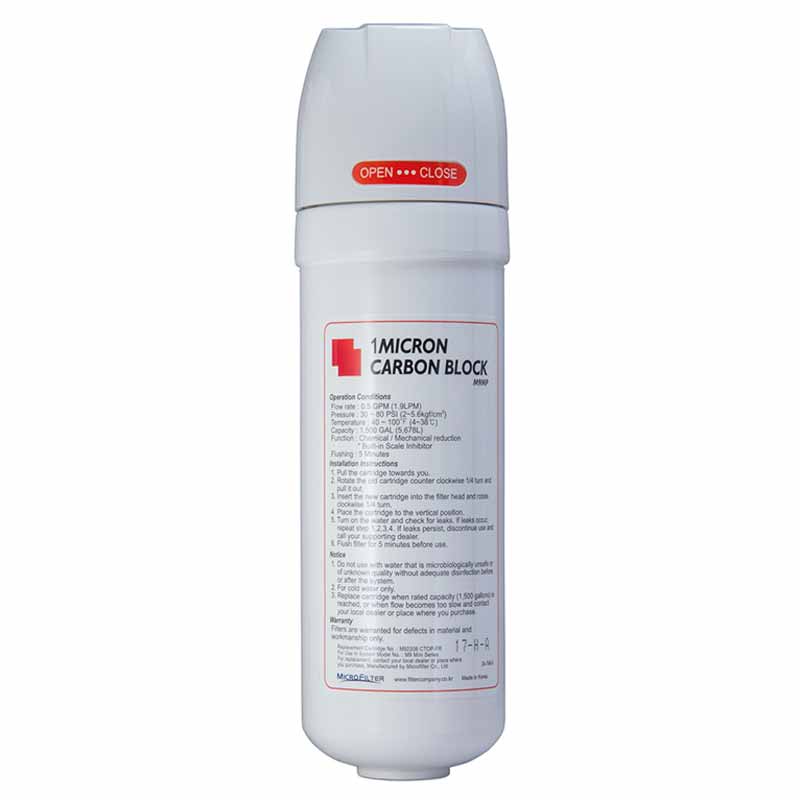
This Microfilter M9MP review examines practical fit, evidence limits, installation or handling, maintenance and alternatives. It is researched guidance, not a hands-on test.
Jump to a buying question
- Compare complete arrangements
- Ask what the rating means for your objective
- Supplier-confirmed appliance list and replacement schedule
- Our assessment
- Microfilter M9MP review: start with the exact model and the job
- A hypothetical purchase: a suitable cartridge in an incomplete basket
- Define the water-treatment objective in one sentence
- M9MP and M9M should remain distinct identities
- What the retailer says about the current package
- A micron number is not a complete performance certificate
- Keep scale inhibition separate from conventional softening
- Capacity and time limits answer different questions
- Treat catalogue leads as leads, not completed evidence checks
- What the Kiwa certificate copy does and does not cover
- Confirm the head and cartridge as an assembly
- Under-sink space has to work during a cartridge change
- Choose the outlet before choosing the cheapest variant
- A first installation should have an itemised scope
- Operating limits need to match every part of the supplied arrangement
- Commissioning and flushing should be recorded
- Quick-change convenience does not remove maintenance responsibility
- A replacement purchase starts with the fitted equipment
- When taste or flow changes, give support a useful description
- Holidays and low-use properties need a separate plan
- Build running costs from confirmed intervals
- Compare M9MP with Q5586 under the same brief
- Consider another brand or no additional treatment
- A practical question list to send before ordering
- What the supplier reply resolves
- Our conclusion: shortlist conditionally, then settle the remaining details
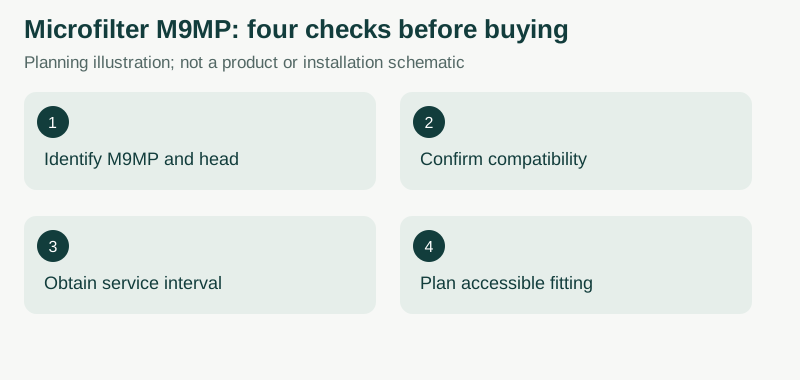
The Microfilter M9MP is a shortlist candidate for a defined point-of-use filtration requirement. The buying decision depends on the exact package and the evidence behind the claim you need.
Compare complete arrangements
Filter Flair describes a 1-micron carbon-block system with scale inhibitor, 5,678-litre capacity and a head with quarter-inch connections and automatic shut-off. Tap packages differ from the base option. Confirm the included fittings before comparing installed costs. Retailer listing.
A lower headline price can still require an outlet, additional fittings and labour. Write the intended installation as a small parts list. Then ask the retailer or installer to confirm each item against the model code you plan to order.
Ask what the rating means for your objective
A micron figure is not a universal contaminant-removal certificate. Request the exact system's performance evidence and operating conditions for any substance you intend to reduce.
Do not infer conventional softening from the inhibitor description. If your objective is less descaling, ask how the retailer expects that result to be assessed and what maintenance it depends on. If the objective is a health-related concern, that needs its own evidence and appropriate advice.
Supplier-confirmed appliance list and replacement schedule
Jordan Spencer of Filter Flair confirmed by email on 2 November 2026 that the appliance list headed “M9M” on its M9MP page also applies to M9MP, and acknowledged the unclear wording. This resolves list applicability as supplier confirmation. Confirm your exact appliance model, fitted head, connections and any adapters; we have not independently installation-tested the list or verified complete-system performance certification.
Filter Flair confirmed by email on 2 November 2026 that M9MP should be replaced every six months or after 5,678 litres, whichever comes first. Incoming water quality, noticeably reduced flow or returning unwanted taste or odour may require earlier replacement. Record the fitting date and usage; low consumption does not extend the six-month limit. Taste, odour and flow are maintenance indicators, not proof of drinking-water safety or contaminant-removal performance.
Our assessment
Consider M9MP alongside Q5586 for a specified point-of-use carbon-filter task. Choose on confirmed evidence, package completeness, fitting and maintenance support. We cannot establish a performance winner from the available listings, and the smaller micron number alone does not settle the purchase.
Continue your research: water filter types, softener vs filter, water filter replacement schedule.
Microfilter M9MP review: start with the exact model and the job
This Microfilter M9MP review is for a buyer considering a point-of-use carbon-filter arrangement, not a whole-house softener or a temperature-controlled drinking-water station. The useful question is whether the exact cartridge, supplied head, outlet and maintenance plan match a defined task in your kitchen. A familiar brand name or a small micron number does not settle that question on its own.
M9MP belongs on a shortlist when the complete package, installation fit and relevant performance evidence match the task. Filter Flair has resolved the replacement-interval and appliance-list questions. These written supplier confirmations do not establish independently tested performance.
We have not installed, tasted, flow-tested or independently evaluated this system. The practical situations below are planning examples rather than reports of our experience. The recommendation is based on the clarity of the buying decision and on supplier-attributed information, with open questions left open. That distinction is especially important when several similar model names appear in the same product family.
A hypothetical purchase: a suitable cartridge in an incomplete basket
Imagine buying a filter because the photograph shows everything you think you need. When it arrives, you discover that the version ordered does not include the outlet or connectors required in your kitchen. Nothing in that situation establishes a fault with the filter itself, but the original price comparison has become less useful. This is a hypothetical example of a scope problem, not a report about a Filter Flair delivery.
Before comparing prices, list the cartridge, head, bracket where applicable, connections, tubing, outlet, installation and commissioning. Have the retailer mark which items are included in the precise variant you intend to buy. If an existing part will be retained, identify it by model and obtain compatibility confirmation. Avoid a plan that relies on the installer discovering the missing pieces after the order arrives.
A complete basket can still be good value, but value should refer to a working outcome. A cartridge-only option, a cartridge with head and a tap package have different boundaries. Once those boundaries are visible, you can compare M9MP with Q5586 or another system on a fairer basis than simply choosing the lowest number on a product page.
Define the water-treatment objective in one sentence
Write down what you want to change and where. An example might be a preferred drinking-water taste at the kitchen sink. Another might involve a particular substance identified in a report. Scale throughout a property is a different task. A broad phrase such as cleaner water does not tell you which product evidence is relevant or whether this treatment category is appropriate.
For a specific substance, ask for evidence for the exact intended assembly and claim. For an ordinary taste preference, compare the documented aesthetic function and the ownership routine. For unknown or potentially unsafe water, obtain appropriate supply advice rather than assuming a domestic carbon block makes every feed acceptable. This review does not establish that your home needs additional treatment.
The one-sentence brief is also a defence against unnecessary complexity. It helps you recognise when a more expensive dispenser offers useful functions and when it simply adds functions unrelated to the task. It also helps you recognise when a modest filter is being asked to deliver an outcome that has not been supported. The right scope is the one that answers the brief with appropriate evidence and manageable care.
M9MP and M9M should remain distinct identities
Jordan Spencer of Filter Flair confirmed by email on 2 November 2026 that the appliance list headed “M9M” on its M9MP page also applies to M9MP, and acknowledged the unclear wording. This resolves list applicability as supplier confirmation. Confirm your exact appliance model, fitted head, connections and any adapters; we have not independently installation-tested the list or verified complete-system performance certification.
Retain the exact cartridge and head codes with the invoice and installed label. Similar names can be useful clues to a product family, but they do not establish that the media, intended claims or use cases are identical. A replacement selected from a photograph or a partial code can be harder to verify than one selected from the installed documentation.
This is not pedantry. A household may keep the head while replacing consumables over several years. The information needed later is the identity of what was actually fitted, not the wording of a search result remembered from the first purchase. A clear record protects the usefulness of the installation even if retailer page titles or package options change.
What the retailer says about the current package
Filter Flair describes a one-micron carbon-block system with a scale inhibitor and a rated capacity of 5,678 litres. It describes a head with quarter-inch push-fit connections and an automatic shut-off feature. Tap variants are offered separately from the base option. These are retailer descriptions, not measurements or installation findings established by Limescale Logic.
Confirm the exact selected variant and what comes with it. The presence of several options can make a product photograph ambiguous as a parts list. Ask whether the tap, tubing, valve and any necessary adapters are included for your chosen basket, then have an installer confirm what the actual kitchen needs. Do not assume that every supplied fitting is suitable for every property.
Keep the package description separate from performance evidence. Knowing what arrives in the box helps plan installation, but it does not establish the scope of contaminant reduction, certification or compatibility with a particular appliance. A useful purchase record contains both kinds of information without allowing one to stand in for the other.
A micron number is not a complete performance certificate
A micron figure describes a rating that needs context. It does not, on its own, establish reduction of every dissolved substance, microorganisms or any particular health-related concern. Ask what the rating means for the exact cartridge, under which test conditions and for which claim. Avoid converting a smaller number into a universal quality ranking.
If the comparison is with Q5586, begin with the actual objective and the evidence each supplier provides. Different media arrangements can have different intended functions. A specification that appears more precise can still leave important questions unanswered about operating conditions, service life or the complete supplied assembly. Precision in one field is not completeness across the whole purchase.
We have not independently verified complete-system performance certification for M9MP. The review therefore reports the supplier's description and identifies the documents a buyer should request. If a particular reduction claim is essential, make satisfactory evidence a condition of the decision. Do not use the review's existence or an affiliate link as a substitute for that missing evidence.
Keep scale inhibition separate from conventional softening
The scale-inhibitor description should not be read as a promise that hardness minerals are removed or that every outlet in the home receives softened water. Ask what the feature is intended to achieve in the proposed application, under what conditions and with what evidence. A point-of-use filter can have a valid role without being equivalent to an ion-exchange softener.
If the purpose is a particular appliance, name that appliance and obtain confirmation of the compatible arrangement. Ask how the expected scale-related result should be assessed and what maintenance it depends on. Do not infer the result from a generic image of a clean heating element or a broad phrase about hard-water areas.
If recurring deposits at showers, taps and appliances are the main concern, investigate the whole-home treatment question separately. The right conclusion may involve different equipment or no immediate purchase while the problem is identified. Our M9MP assessment is more useful when it preserves the boundary of the claim than when it stretches a compact filter's description into a universal answer to limescale.
Capacity and time limits answer different questions
Filter Flair confirmed by email on 2 November 2026 that M9MP should be replaced every six months or after 5,678 litres, whichever comes first. Incoming water quality, noticeably reduced flow or returning unwanted taste or odour may require earlier replacement. Record the fitting date and usage; low consumption does not extend the six-month limit. Taste, odour and flow are maintenance indicators, not proof of drinking-water safety or contaminant-removal performance.
Likewise, a busier household should not assume a calendar reminder is the only relevant limit. The applicable instructions may set volume, time or other conditions that require attention sooner. Ask for those conditions together and record the exact model to which they apply. If several components have different schedules, track them separately rather than treating the whole assembly as a single consumable.
For running-cost planning, allow for at least two scheduled cartridge replacements per year under the supplier’s six-month-or-5,678-litre schedule, whichever comes first, with earlier changes if volume or conditions require them. Confirm current cartridge prices, delivery, labour and other costs separately. The interval does not demonstrate a performance advantage or establish a guaranteed annual total.
Treat catalogue leads as leads, not completed evidence checks
H2O Direct's indexed M9 catalogue distinguishes M9M and M9MP and associates the inhibitor feature with M9MP. That is a useful source lead for understanding the product family. The full catalogue was not retrievable through the text-reading route used for this review, so we do not present the indexed extract as a complete current manufacturer manual.
Ask the retailer for the current Microfilter documentation that applies to the cartridge and head it supplies. A distributor catalogue can describe a range without establishing every installation condition or service interval for the exact package. The current component identity and application remain the anchors for a buying decision.
This distinction also prevents a common evidence error: finding a plausible technical document and then allowing it to answer questions it never addresses. A specification lead may establish where to research further while leaving compatibility and maintenance open. A responsible review should say that explicitly. We have done so rather than treating the existence of an indexed document as proof that all supplier questions are resolved.
What the Kiwa certificate copy does and does not cover
We read a Kiwa certificate copy hosted by H2O Direct, number 2309706, whose appendix includes M9M and M9MP among water-filter heads. Its scope concerns cold-water fittings and materials, with stated installation and backflow conditions. That is not the same as evidence that the complete supplied system achieves a particular contaminant-reduction result.
The copy gives an issue and expiry period, but we have not independently checked current register status. Consequently, we do not describe the whole M9MP system as currently certified for broad performance on the strength of that document. A current register check and a precise explanation of scope would be needed before using certification wording more widely.
Ask a supplier citing the document to identify what it covers and how it relates to the items in the basket. A narrow approval can be valuable when described correctly. Problems arise when a materials or fittings document becomes a headline about all water-treatment outcomes. Keeping the scope visible is more informative than either ignoring the evidence or overstating it.
Confirm the head and cartridge as an assembly
Ask for both identities, not just a cartridge name. The head may remain in place through repeated consumable changes, so its instructions and condition belong in the ownership record. If you already have an M9-family installation, identify the existing head before assuming that a new cartridge is the correct replacement. A shared family name is not the whole compatibility check.
Have the installer explain how the head is mounted and supported and what access is required. Confirm the intended connections for the actual feed and outlet. If an automatic shut-off feature is advertised, continue to follow the complete instructions for isolation and servicing rather than treating the feature as permission to skip preparation.
At handover, keep a component list with the invoice and manual. If a part is substituted during installation, record the substitute. This is not unnecessary administration: it gives a future service provider a reliable starting point. The system you own is the set of parts fitted in the kitchen, which may be more specific than the short name shown on an online product page.
Under-sink space has to work during a cartridge change
Measure the cupboard with its normal plumbing and storage in place. Include the sink bowl, trap, waste connections, nearby appliances and existing pipe routes. Ask for the complete assembly dimensions and the clearance needed to remove and replace the cartridge, not merely the dimensions of a loose consumable. The service movement can require space that the installed unit does not occupy continuously.
Think about who will perform the task. Can that person reach the filter, see the relevant parts and handle any water as directed? Is the isolation accessible? Is there a practical place for the items used during a change? A position that suits a photograph of an empty cupboard may be inconvenient after normal kitchen storage returns.
If the only way to service the unit is to pull on tubing or repeatedly move connected equipment awkwardly, ask for a better plan. The point is not to dictate a mounting method through this review. It is to make maintainability an explicit purchase requirement. A small filter that can be cared for properly is a better ownership proposition than a neatly hidden arrangement that nobody wants to access.
Choose the outlet before choosing the cheapest variant
The system's tap options affect the complete basket. Decide whether you need a new dedicated drinking-water outlet, can retain a confirmed compatible one, or need a different arrangement. Have the seller and installer identify the parts required for that choice. Do not assume that a tap appearing in one photograph is included with every variant.
Measure the vessels used most often. A tall bottle, a jug and an ordinary mug can place different demands on the outlet position. Consider how the tap works around the sink, window, cupboard doors and dish rack. Those everyday details influence whether the installation is useful, even though they do not change the cartridge's media description.
If considering a combined tap, ask for compatibility confirmation for that exact model and filter assembly. A shared reference to filtered water is not enough. The final installation plan should explain which path supplies which outlet and how the arrangement is maintained. That is easier to settle before purchase than after discovering that a preferred tap changes the component basket or the required work.
A first installation should have an itemised scope
Ask for a quotation that identifies the equipment, supplied fittings, additional parts, labour and commissioning. Describe the intended location and existing outlet accurately. If the installer has not inspected the space, ask what assumptions remain and how an unexpected condition will affect the quotation. A clear scope prevents a small product price from becoming a misleading estimate of the final cost.
The current manufacturer and complete-system instructions should govern the work. Use an appropriately competent installer where needed and do not adapt generic fitting steps from another product. We have not assessed your plumbing, so this review does not prescribe a connection method or establish that the supplied accessories suit your particular property.
Before the visit ends, the owner should know what was fitted, where isolation is located, which instructions apply and how replacements are identified. Ask for any substitutions to be written down. A successful installation is more than a tap that produces water on the day; it is an arrangement that remains understandable and maintainable when someone else has to service it later.
Operating limits need to match every part of the supplied arrangement
Ask the supplier to confirm the feed conditions for the complete current system, including pressure, temperature, water quality and any necessary upstream measures. Do not combine the most generous numbers from different documents into a new operating envelope. A head, cartridge and outlet may each have relevant conditions that need to be considered together.
If documents differ, have the supplier clarify the applicable limits for the basket being sold. Explain any existing treatment equipment or unusual supply arrangement so that the answer relates to the actual installation. Do not assume that adding several treatment devices in sequence automatically improves the result or preserves the conditions under which a claim was assessed.
Keep the applicable document with the installation record. If an installer measures feed conditions, retain those results and ask how they compare with the requirements. These questions help make the purchase specific without turning the reader into an engineer. A clear written answer is more useful than a general statement that the system works in most kitchens.
Commissioning and flushing should be recorded
Obtain the current first-use and replacement procedures for the actual assembly. Ask the installer to explain which commissioning tasks are complete and what, if anything, the owner must do before regular use. We do not supply a generic flush duration or volume for M9MP because the manufacturer-specific instruction remains part of the documentation request.
If a seller gives an instruction verbally, ask for the relevant written source or confirmation. That makes it easier for another household member to follow the same procedure later. It also prevents an instruction for a different cartridge in the same family from being remembered as the instruction for this one. Similar-looking components should not erase model distinctions.
Record the installation and first-use dates, then link them to the confirmed replacement schedule. Keep any initial concern visible in the record and contact support where needed. Appearance and taste are not universal proofs that every performance or commissioning requirement has been satisfied. Follow the applicable procedure rather than using a review as a substitute manual.
Quick-change convenience does not remove maintenance responsibility
A convenient consumable change is useful only if the right part is obtained and the full procedure is followed. An automatic feature described on a listing does not establish that no isolation, preparation, inspection or recommissioning is required. Ask for the complete routine, including the conditions under which the feature is intended to operate.
Decide who will look after the installation. Keep the model code, supplier contact, instructions and dates in a place that person can access. If maintenance is contracted out, ask what the service includes and what remains the owner's responsibility between visits. If the owner performs permitted routine work, confirm that the access and instructions are manageable.
Out-of-sight equipment can be easy to forget. The best reminder names the component and the reason for the task rather than simply saying service filter. A record of completed work makes later decisions easier and gives a service provider context if something changes. That administrative convenience can be more valuable over several years than saving a small amount on a consumable ordered without a clear schedule.
A replacement purchase starts with the fitted equipment
If you already own an M9-family system, begin with the label and instructions for the head and cartridge in place. Identify the exact replacement code and ask the supplier if anything is unclear. Do not assume that a product with a similar image or a shorter model name is automatically appropriate. The family relationship is a clue, not confirmation of every application.
Explain whether the replacement is routine or prompted by a problem. Those are different questions for support. A scheduled change needs the right part and current procedure; an unexpected operating change may require assessment of the complete arrangement. This review does not diagnose a fault from a general symptom and does not recommend bypassing equipment as a shortcut.
Once the task is complete, update the installation record with the code, date and any relevant observations. If a different part is supplied, retain the written explanation of why it is suitable. That avoids passing uncertainty forward to the next replacement. The aim is a system whose identity becomes clearer over time, rather than one whose history is progressively lost.
When taste or flow changes, give support a useful description
Record what changed, when it began and whether it followed a replacement, plumbing work or inactivity. Identify the equipment and any recent maintenance. A concise account helps the supplier decide what information is needed next. It is more useful than assuming that every change means the same component has failed or that every taste concern is a filtration-performance result.
Follow the current troubleshooting and safety directions. For leaks or other concerns, obtain appropriate help rather than dismantling the assembly on the strength of a review. We have not serviced M9MP and do not prescribe a repair sequence. A symptom can arise from several parts of an installed arrangement, including conditions outside the cartridge itself.
Before buying, ask who handles technical support and what the process involves. Clarify whether the retailer advises on the complete kit, replacement selection and installation questions. A clear service route is an ownership benefit you can evaluate without making unsupported claims about reliability. It can also make a small difference in purchase price less important than the availability of accurate assistance.
Holidays and low-use properties need a separate plan
Ask for the current inactivity and return-to-use guidance for the exact assembly. Do not borrow a flush interval from Q5586, an older M9 document or a different brand. A volume rating does not explain what happens after an extended period without use. The applicable instructions need to address that situation directly.
If the property is frequently empty, tell the supplier before buying. Describe the length and frequency of absences and ask how the required routine fits them. That may influence which treatment format is most convenient. It is not proof that an under-sink carbon system is unsuitable; it is part of matching the ownership responsibilities to the actual calendar.
Keep any shutdown and restart instructions with the maintenance record, and make them accessible to the person responsible for the property. Do not rely on another household member remembering a short conversation months later. A useful review considers the weeks when nobody uses the tap as well as the busy days when its convenience is most visible.
Build running costs from confirmed intervals
For running-cost planning, allow for at least two scheduled cartridge replacements per year under the supplier’s six-month-or-5,678-litre schedule, whichever comes first, with earlier changes if volume or conditions require them. Confirm current cartridge prices, delivery, labour and other costs separately. The interval does not demonstrate a performance advantage or establish a guaranteed annual total.
Compare the same boundary with another product. A retailer's cartridge price may omit head, outlet or fitting work that another basket includes. Likewise, one schedule may be fully documented while another remains uncertain. The worksheet should show these differences rather than smoothing them into a deceptively neat annual figure.
If you compare five years, keep purchase, installation and recurring costs separate. Add any repair or replacement allowance as a labelled planning assumption, not a prediction of what will happen. The purpose is to reveal which unanswered question could change the choice. A good cost comparison can end with a request for one supplier answer instead of an artificial winner.
Compare M9MP with Q5586 under the same brief
Q5586 has an accessible model-specific manufacturer sheet. Filter Flair has now confirmed M9MP’s replacement interval and appliance-list applicability, so those earlier uncertainties are no longer reasons to discount M9MP. Compare exact installation fit, complete package, maintenance costs and model-specific performance evidence. Q5586’s accessible sheet remains a documentation distinction, not proof of a measured performance winner.
Ask the same questions about both systems: exact cartridge and head, applicable claim, complete basket, feed conditions, service interval, capacity, installation and support. A confirmed compatibility advantage in your existing setup could change the recommendation. So could a more appropriate documented claim or a clearer maintenance arrangement. The comparison should explain those conditions rather than hiding them behind a universal score.
M9MP remains a candidate when its specific arrangement matches the task. The two supplier clarification questions are resolved; current manufacturer instructions and independent complete-system performance evidence remain separate checks.
Consider another brand or no additional treatment
A worthwhile comparison can include products for which this site earns no commission. BRITA's official mypure P1 page describes another under-sink drinking-water arrangement with its own dispenser and cartridge. It is a research alternative, not a model we have tested or endorsed as a direct replacement. Compare the current documentation, complete basket and intended claim separately.
An alternative can also be a different format: a refillable dispenser, an installed RO outlet or a whole-home assessment where that is the actual need. Do not assume that a carbon cartridge and an RO station answer the same question simply because both appear on a water-products page. Define the treatment objective and the convenience features before comparing brands.
Sometimes the appropriate result is no purchase yet. If you cannot name the problem or the desired change, gather the relevant supply information first. Affiliate links do not create a reason to treat water that has no established treatment brief. A responsible recommendation should leave room for the simplest sufficient arrangement, including retaining what already works.
A practical question list to send before ordering
Ask the retailer to identify the supplied cartridge and head, confirm every included item for the selected variant, and provide current manufacturer documentation. Filter Flair has confirmed six months or 5,678 litres, whichever comes first, and that its M9M-headed appliance list applies to M9MP. Confirm installation-specific conditions and obtain current flushing and inactivity instructions.
Add your own installation brief: the intended outlet, existing components, available space and any appliance connection. Ask for confirmation under that brief rather than requesting a broad assurance that the filter is compatible. If a certification or performance claim matters, ask for the exact document and scope for the supplied assembly.
Keep the answer with the quotation. Mark which questions are answered, which require an installer and which remain open. Do not allow an unanswered question to become a positive assumption when moving items into the basket. The point of this exercise is not to delay a suitable purchase indefinitely; it is to ensure that the decision rests on the system you will actually receive and use.
What the supplier reply resolves
Filter Flair’s 2 November 2026 email resolves replacement timing and appliance-list applicability. We report these as supplier confirmation, not our own installation test. Current manufacturer instructions and independent performance evidence remain separate requests; any later documents will be reviewed for their exact model and scope.
A reply would not automatically verify independent performance certification or prove a health-related outcome. Each claim still needs the relevant evidence. We would retain the distinction between a manufacturer specification, retailer advice, fittings approval and an independent test rather than treating them as interchangeable forms of proof.
We would also update the review if the kit contents, model revision or support arrangement changed. A product review is a maintained decision aid, not a permanent verdict attached to a name. The useful update tells readers what changed and why it affects the purchase, while preserving the researched-review disclosure and avoiding an invented account of hands-on experience.
Our conclusion: shortlist conditionally, then settle the remaining details
M9MP deserves consideration for a defined point-of-use carbon-filter task when the complete package, compatibility and care routine are confirmed. Its advertised compact arrangement and scale-inhibitor feature are reasons to investigate the supplier information, not reasons to infer whole-home softening or universal treatment performance. We do not declare it defective because a documentation question remains.
We would prioritise a clearly documented complete arrangement over a small headline saving or an isolated specification number. That means obtaining the correct cartridge and head, an appropriate outlet, accessible installation and a confirmed replacement schedule. It also means knowing who will provide help if an unexpected operating change occurs.
If those answers fit your brief, check the current retailer options and the exact basket before buying. If they do not, compare Q5586 and the alternative routes. The aim is a choice that stays understandable after installation, with benefits you can explain and responsibilities the household can follow. That is a more useful result than a confident rating built on unverified assumptions.
Alternative research: BRITA mypure P1 official product information. This is a research lead, not an affiliate endorsement or a hands-on review.